What's this? My half-finished sails getting publicity at Steve Earley's blog but not here? Fie!
Well, no longer. Here are some shots Stuart at Dabbler Sails sent me, showing the work in progress on the mainsail. It's made from cream-colored Dacron, and you can see where the full battens will go and notes on how to set up the lacing.
Great stuff, and Stuart does superb work. In fact, one of the benefits of working with him has been an extended education in the details of sailmaking, since he's also making Steve's sails this winter. (Steve sails Spartina, a Welsford Pathfinder, the same design as mine, and continues to be an inspiration in both boatbuilding and cruising.)
Unfortunately, my mast-building has not seen similar speedy progress. With daytime highs in the 20s this week, and overnight lows in the teens, I need some way to heat the mast pieces to at least 40 degrees so the glue can set.
Last night I set up a practice gluing station: heat lamps, plastic sheeting, and a digital thermometer. It was 19 degrees outside this morning -- nose-hair freezing weather. Temperature under the plastic? 38 degrees: not warm enough.
Next chapter in the saga: I Attempt To Fit A Fourteen Foot Mast Inside the Warm House; Interesting Result.
Showing posts with label boatbuilding. Show all posts
Tuesday, January 22, 2013
Monday, December 10, 2012
Whiskey Plank
In old-timey shipbuilding (the best kind), the whiskey plank was so named because at this important milestone in the construction, the last plank was attached and the hull was complete. Shipbuilders would mark the occasion with a dram (or more) of whiskey.
And so although my boat is not those ships "which in old days moved earth and heaven," it still ploughs the same seas and bends to the same winds that caress and torment this world and the men and women who voyage out on the watery wild.
Last week it was time for a glass of fiery Talisker!
This shot, peeking over the transom, shows the buoyancy and surprising size of this boat. It's a big 17-foot boat.
You can also see the grublike bundle of plastic sheeting I've been using to wrap over curing epoxy to hold the heat in from work lamps. Works pretty good.
And so although my boat is not those ships "which in old days moved earth and heaven," it still ploughs the same seas and bends to the same winds that caress and torment this world and the men and women who voyage out on the watery wild.
Last week it was time for a glass of fiery Talisker!
This shot, peeking over the transom, shows the buoyancy and surprising size of this boat. It's a big 17-foot boat.
You can also see the grublike bundle of plastic sheeting I've been using to wrap over curing epoxy to hold the heat in from work lamps. Works pretty good.
Saturday, November 24, 2012
It's a boy
Bowsprit dry-fitted to see how it looks.
It looks good.
Even Samson the Critical Gorilla strikes an approving pose.
It looks good.
Even Samson the Critical Gorilla strikes an approving pose.
Monday, October 29, 2012
Snowicane
It started with a ghostly ring around the moon, and then three days of clouds creeping slowly, like glaciers or the tide, across the sky, from horizon to horizon.
Then the wind started: a tickle here, leaves scraping down the road there, rustlings in the woods at night. A few dead branches falling and scaring the dogs. But the wind didn't stop. After a day or two you didn't really notice it anymore: the smaller branches swaying rhythmically, leaves fluttering.
It blew for three days. The sky turned yellow. And then it began to rain, at first so gently that you couldn't tell if it was mist or fog instead of thing little droplets.
It's been raining all night and all day now, and the wind is still swaying the smaller branches. The dogs are anxious. There's a strange darkness to the light, like a fire seen through a black shirt, or through dirty smoke.
It is going to get worse before it gets better. We have flood warnings, high wind warnings, severe weather warnings, and now (I can hardly believe it) a blizzard warning.
View from the workshop: only the sheerplank on each side remaining now.
Then the wind started: a tickle here, leaves scraping down the road there, rustlings in the woods at night. A few dead branches falling and scaring the dogs. But the wind didn't stop. After a day or two you didn't really notice it anymore: the smaller branches swaying rhythmically, leaves fluttering.
It blew for three days. The sky turned yellow. And then it began to rain, at first so gently that you couldn't tell if it was mist or fog instead of thing little droplets.
It's been raining all night and all day now, and the wind is still swaying the smaller branches. The dogs are anxious. There's a strange darkness to the light, like a fire seen through a black shirt, or through dirty smoke.
It is going to get worse before it gets better. We have flood warnings, high wind warnings, severe weather warnings, and now (I can hardly believe it) a blizzard warning.
View from the workshop: only the sheerplank on each side remaining now.
Wednesday, October 10, 2012
Plank installed
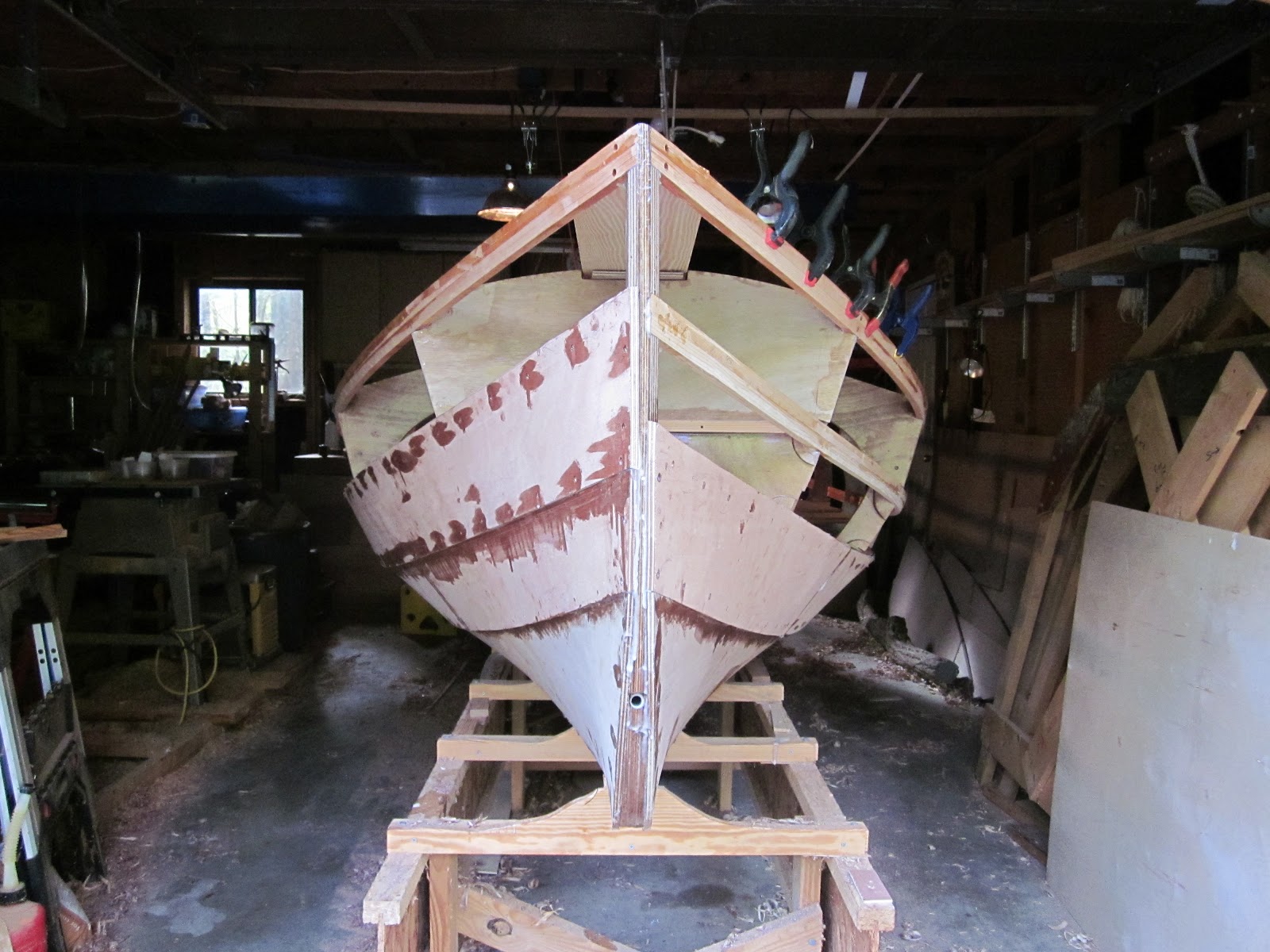
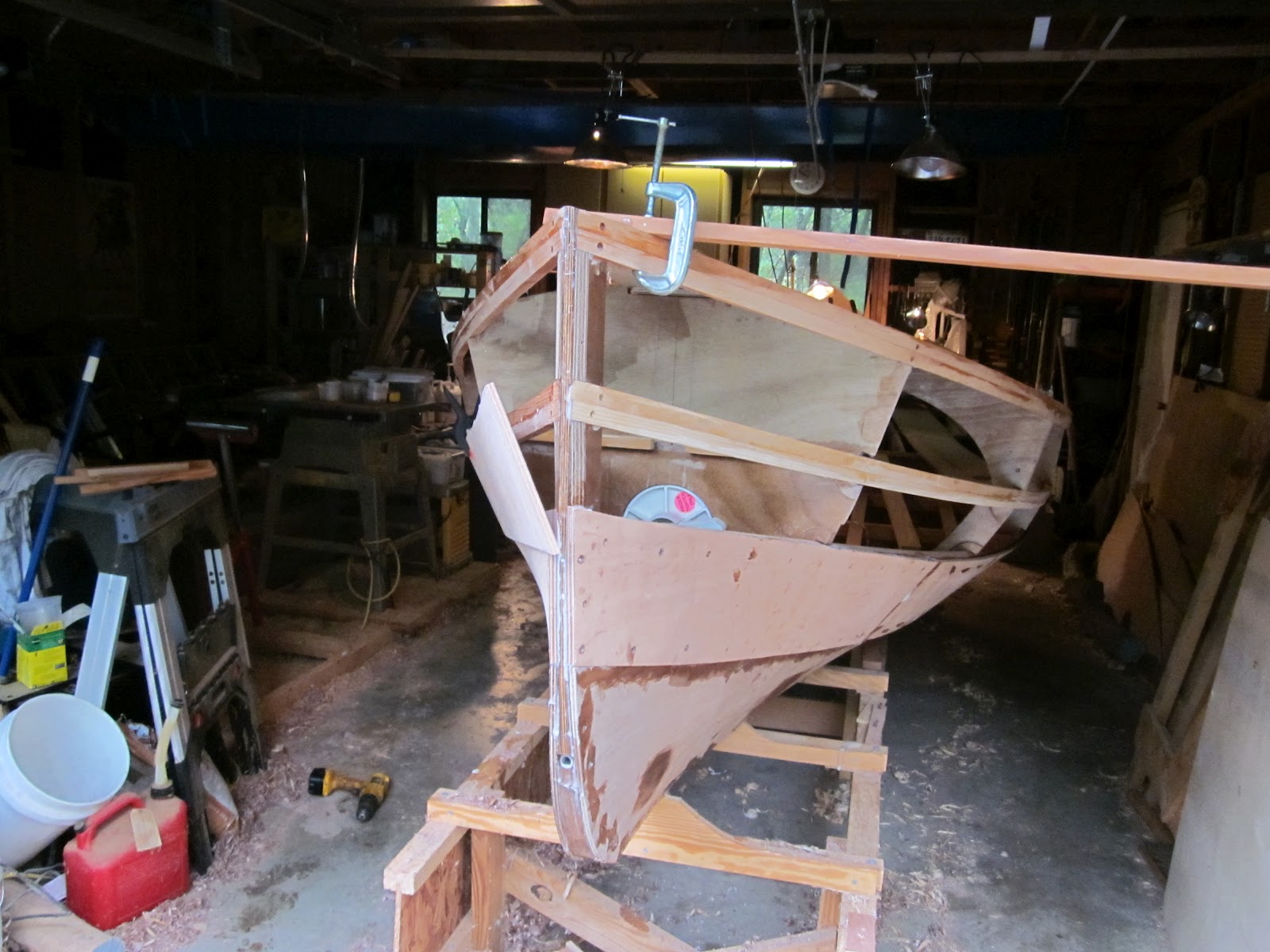
... and here's what it looks like now, after the glue has dried and I've removed the army of spring clamps. Nice and flush at the bow (that's why you cut the gain where the planks overlap).
Another view of the bow, really showing the work to date ... and what's still remaining: two port planks and the last one -- the sheerplank -- on the starboard side. I flatter myself that the boat might float now if I put it in the water. You can even see some out-of-favor deserters from my clamp army slouching at attention on the port sheer stringer.
Tuesday, October 9, 2012
Scenes from a plank
Planking is fun because all of a sudden, the boat's taking shape right there in front of you. What makes it tricky is that neither the plank nor the boat are flat ... and bent wood likes to spring back to being straight.
Here we have a few shots of getting Plank #2 on the starboard side ready to be glued. Each side has four planks, numbered up from the bottom, so this is the next-to-last plank on that side:
Here on the left side of the picture you can see the (loose-fit) plank curving away from the bow because I haven't clamped it in place. I'm testing the gain, which is a long, wedge-shaped cut on the plank below it to allow the overlap to become flush as the planks meet at the bow.
Same thing, different angle. Also note that our garage features a similar sort of lapstrake planking as the boat. 'Cept the boat is better made.
Plywood comes in 8-foot sheets; the boat is over seventeen feet long, so the planks need to be attached together with a scarf joint. In this shot, looking forward from the stern, the plank in question is clamped in place and you can see the vertical stripes where I cut the long angle. The aft-most piece of the plank, with a matching angle in its forward edge, will be joined here.
Here we have a few shots of getting Plank #2 on the starboard side ready to be glued. Each side has four planks, numbered up from the bottom, so this is the next-to-last plank on that side:
Same thing, different angle. Also note that our garage features a similar sort of lapstrake planking as the boat. 'Cept the boat is better made.
Plywood comes in 8-foot sheets; the boat is over seventeen feet long, so the planks need to be attached together with a scarf joint. In this shot, looking forward from the stern, the plank in question is clamped in place and you can see the vertical stripes where I cut the long angle. The aft-most piece of the plank, with a matching angle in its forward edge, will be joined here.
Next: the finished plank in position!
Wednesday, May 23, 2012
Stringers
The downsides are the number of clamps involved (I've resorted to lashing stringers to the frames with cord when I run out of clamps) and the high-tension bendiness of curved wood. Wrapping the stringers in towels, then pouring boiling water over them and wrapping in plastic for an hour steams the sass out of them.
Well, some of it.
View from the bow. Here you can see the angled notch cut into the forefoot to receive the next stringer -- in this case, #3 on the port side. (I numbered them from the top. Five total.)
You can also get a sense of the sweet knife-edge twist those bottom planks will take as they curve from the sides into the narrow forefoot. Not looking forward to wrestling those into place.
The round hole in the bulkhead will be fitted with a small hatch, so you can reach into the forepeak for light storage (lines, etc.). Had to cut that some weeks ago, as now that the stringers are nearly on, it's hard to reach through the sides of the boat!
Wednesday, April 11, 2012
Eight clamps
This is a photo of the aft end of the lower port stringers where they meet the transom. Where the support structures of the side of the boat meet the back of the boat.
They twist in all three dimensions! (Four, I guess, since they started out not nearly as twisty and have assume their corkscrew shape over time.) This is why I had to use limber fir instead of strong but brittle yellow pine for these stringers.
And the clamping. Complexity incarnate. The lack of right angles and things to clamp to means you have to get creative. Some of these clamps are only there to hold other clamps in place! Eight clamps to hold pieces of wood to other pieces of wood.
But it held, I predrilled, glued, and screwed, and the epoxy is curing as I type this.
Sunday, June 5, 2011
Clamps ahoy
Clamping the port lower sheer stringer -- an eighteen-foot piece of floppy fir that curves in three dimensions (and some days, four) -- requires clamps. Lots and lots of clamps:

What you see here is:
What's neat about this stage of the build is that the shape of the boat -- a leaf, a cockle, the curve of a gull across the sky -- really starts to show itself. Squint if you can, and look past the clamps and bracing to see the edge of the boat, arcing up toward the bow.
And later, lo, the boatbuilder was tired and retired inside where the lion hath laid down with the lamb. For lo, he opened a beer and all was right with the world.
What you see here is:
- The stringer itself, or its lower half at least, going diagonally across the shot. It fits into a notch in a frame.
- The frame itself is braced and clamped to withstand the Herculean forces applied by my muscles and the stringer as I torque it into position.
- Two pinch clamps holding cedar wedges in place. So I cut the notch too big and had to wedge it out. What?
And later, lo, the boatbuilder was tired and retired inside where the lion hath laid down with the lamb. For lo, he opened a beer and all was right with the world.
Friday, May 27, 2011
Now I have a fly swatter. Ho ho ho.
The trouble with hitting, or trying to hit, cave crickets with scraps of wood is that I get worried about banging up the boat. And if I end up damaging the boat while attempting to dissuade cave crickets from whatever it is that they do, my rage will be Biblical.
So I picked up a fly swatter. Fly swatters are kind of hard to find. Maybe the Internet has made them obsolete; for all I know there's some kind of e-swatter everybody's downloaded. But I was able to find an archaic "real" fly swatter.
I'm not sure it will be able to withstand the crispy, horned carapace of a cave cricket, but I'm willing to give it a try.
Except that, now that I've hung the fly swatter in the shop, no cave crickets have shown themselves. Which means that either I've found the right deterrent ... or they are planning something.
Meanwhile, Steve and Bruce, in Steve's boat (the same Pathfinder design I'm building), are rocketing across the Bay in Small Craft Warning conditions. Like I said to a friend once: Small Craft Warnings just mean there's finally going to be some good wind!
So I picked up a fly swatter. Fly swatters are kind of hard to find. Maybe the Internet has made them obsolete; for all I know there's some kind of e-swatter everybody's downloaded. But I was able to find an archaic "real" fly swatter.
I'm not sure it will be able to withstand the crispy, horned carapace of a cave cricket, but I'm willing to give it a try.
Except that, now that I've hung the fly swatter in the shop, no cave crickets have shown themselves. Which means that either I've found the right deterrent ... or they are planning something.
Meanwhile, Steve and Bruce, in Steve's boat (the same Pathfinder design I'm building), are rocketing across the Bay in Small Craft Warning conditions. Like I said to a friend once: Small Craft Warnings just mean there's finally going to be some good wind!
Wednesday, May 18, 2011
Port Sheer
Lately I've been working on the long, gently curved piece of wood that forms the upper left-hand side of the boat. Ugh, just using that lubberly language is like hearing fingernails on a blackboard.
Port sheer stringer. That's better! This is a actually a pair of 18-foot noodly pieces of wood, about 3/4" square in cross section, that arcs from the top outer corner of the transom, out along the side of the boat, and then up and in to the point at the bow. It rolls and spirals, it sweeps down and out and then swoops up and in, a crescendo of fine-grained fir. This defines the shape of the edge of the boat, so it's important to get right.
It's also very difficult to persuade wood to bend in what seems like five dimensions at once. This morning I was struggling with the aft end, where it snugs into a carefully angled notched trimmed into the edge of the transom. What to clamp it to?
Small C-clamp: fail.
Large C-clamp: fail.
Small bar clamp: fail.
Long rope: moderate success.
Long rope with crush-block and bar clamp: moderate success
But not close enough. There's a millimeter of space still to fill, and I'm not going to sink the screw in until that gap is closed ... even though I could get lazy and fill the gap with epoxy.
Just as I threw up my hands this morning and headed inside for coffee (come to think of it, boatbuilding before coffee may have been part of the problem) my eyes fell on Klamp Korner.
Aha.
Klamp Korner is a magical land filled with the boatbuilding equivalent of rainbows and fat-hoofed unicorns: a section of the workshop filled with clamps of all size. Do I have enough clamps? Never. But I do have The BFC: a six-FOOT pipe clamp I used to use to close up 10-by pieces of oak.
I applied the BFC to the problem at hand. It's long enough that it actually extends all the way across the boat to the starboard sheer stringer. A few twists and the port stringer suddenly saw the light of reason. Gap closed.
Now I just have to figure out how to drill through the clamp, or how to move the clamp to access the screw location.
Port sheer stringer. That's better! This is a actually a pair of 18-foot noodly pieces of wood, about 3/4" square in cross section, that arcs from the top outer corner of the transom, out along the side of the boat, and then up and in to the point at the bow. It rolls and spirals, it sweeps down and out and then swoops up and in, a crescendo of fine-grained fir. This defines the shape of the edge of the boat, so it's important to get right.
It's also very difficult to persuade wood to bend in what seems like five dimensions at once. This morning I was struggling with the aft end, where it snugs into a carefully angled notched trimmed into the edge of the transom. What to clamp it to?
Small C-clamp: fail.
Large C-clamp: fail.
Small bar clamp: fail.
Long rope: moderate success.
Long rope with crush-block and bar clamp: moderate success
But not close enough. There's a millimeter of space still to fill, and I'm not going to sink the screw in until that gap is closed ... even though I could get lazy and fill the gap with epoxy.
Just as I threw up my hands this morning and headed inside for coffee (come to think of it, boatbuilding before coffee may have been part of the problem) my eyes fell on Klamp Korner.
Aha.
Klamp Korner is a magical land filled with the boatbuilding equivalent of rainbows and fat-hoofed unicorns: a section of the workshop filled with clamps of all size. Do I have enough clamps? Never. But I do have The BFC: a six-FOOT pipe clamp I used to use to close up 10-by pieces of oak.
I applied the BFC to the problem at hand. It's long enough that it actually extends all the way across the boat to the starboard sheer stringer. A few twists and the port stringer suddenly saw the light of reason. Gap closed.
Now I just have to figure out how to drill through the clamp, or how to move the clamp to access the screw location.
Monday, May 9, 2011
Cave Crickets Beware
For I have returned to boatbuilding.
After some schedule-shuffling, I was in the shop at 6 this morning for a quick spot of epoxying before starting the day. Unfortunately this was also before coffee, but I figured resin and silica powder are not the ideal taste to combine with dark-roast Sumatra, so I was blinking owlishly while mixing the goop and counting to sixty.
I installed the forward port bunkflat supports as the sky cleared into dawn. It was a cool 55 degrees, but warm enough for epoxy to kick, and now, as I happily watch the temperature climb into the 70s, I am wondering why it is that I can still smell epoxy. Occasionally a nub will lodge on my scalp -- a frequent consequence of bending around pieces of wood and bumping into them.
And now that I've returned to the boat, and cleared away the cobwebs, I am going cricket-hunting with a bat of seasoned locust. Attention cave crickets: stay away from my boat or you feel the business end of what I learned in physics: momentum equals mass times velocity. And I can swing a heavy piece of locust.
After some schedule-shuffling, I was in the shop at 6 this morning for a quick spot of epoxying before starting the day. Unfortunately this was also before coffee, but I figured resin and silica powder are not the ideal taste to combine with dark-roast Sumatra, so I was blinking owlishly while mixing the goop and counting to sixty.
I installed the forward port bunkflat supports as the sky cleared into dawn. It was a cool 55 degrees, but warm enough for epoxy to kick, and now, as I happily watch the temperature climb into the 70s, I am wondering why it is that I can still smell epoxy. Occasionally a nub will lodge on my scalp -- a frequent consequence of bending around pieces of wood and bumping into them.
And now that I've returned to the boat, and cleared away the cobwebs, I am going cricket-hunting with a bat of seasoned locust. Attention cave crickets: stay away from my boat or you feel the business end of what I learned in physics: momentum equals mass times velocity. And I can swing a heavy piece of locust.
Wednesday, February 16, 2011
Stop saying query
Query the Third lies jumbled at the bottom of a notebook, coiled like a sleeping snake. When the time is right I shall release it to strike!
What surprises me is how similar these all are. That suggests two possibilities:
1) I have Hit The Mark, and now it's just a matter of reworking sentences. Sentences which must be reworked. I need to revise sentences. Certain sentences demand improvement. Fixing sentences. Reworking phrasing. See what I mean?
2) I've deftly avoided an effective query, but can't jump out of the rut because I've gotten used to it. Human beings can adjust to almost anything: this is our salvation and our curse. In this case I worry that I'm so accustomed to this basic query that it's blinding me to possible alternatives.
Meanwhile, winter's bite is gone from the wind and trees are showing their first tentative buds. Spring trickles in and reminds us that the clock of winter ticks away, ticks away, ticks away.
Yet the boat languishes, a victim of cold weather. How can I glue things -- I bleat plaintively -- when it's too cold for the glue to set? How convenient, I answer, that cold weather arrived just when the revision and query process jolts into high gear.
But with winter ticking away I find myself peering into the garage at the skeletal boat. Soon.
What surprises me is how similar these all are. That suggests two possibilities:
1) I have Hit The Mark, and now it's just a matter of reworking sentences. Sentences which must be reworked. I need to revise sentences. Certain sentences demand improvement. Fixing sentences. Reworking phrasing. See what I mean?
2) I've deftly avoided an effective query, but can't jump out of the rut because I've gotten used to it. Human beings can adjust to almost anything: this is our salvation and our curse. In this case I worry that I'm so accustomed to this basic query that it's blinding me to possible alternatives.
Meanwhile, winter's bite is gone from the wind and trees are showing their first tentative buds. Spring trickles in and reminds us that the clock of winter ticks away, ticks away, ticks away.
Yet the boat languishes, a victim of cold weather. How can I glue things -- I bleat plaintively -- when it's too cold for the glue to set? How convenient, I answer, that cold weather arrived just when the revision and query process jolts into high gear.
But with winter ticking away I find myself peering into the garage at the skeletal boat. Soon.
Friday, October 22, 2010
Workspaces
Coming back from a two-week vacation and launching right into work has meant that the house is full of stacks of (clean) laundry; half-unpacked laundry, water bottles, nearly empty containers of sunblock, shoes and sandals, boarding passes and dinner receipts, national parks brochures, guidebooks.
All great stuff! But it's meant that my normally only-half-messy workspace has become an obstacle course that forces me to high-step through debris to get to the computer.
I deliberately set up my writing space in a small and dark room, facing a bulletin board rather than a window (which is closed most of the time anyway, since I write before dawn). I like the idea of not having a view or a beautiful room to distract me. But when I can't even see the carpet, the mess itself is a distraction. So it has to go.
The same thing goes for "the shop" (garage) where I'm building the boat. How many cars fit into a two-car garage? None, if it's already filled with one boat, a second half-built boat, a kayak, two bikes, a table saw, a workbench, and stacks of lumber. To say nothing of the crickets.
And I can tolerate drifts of wood shavings; clamps not put back in their correct spots (hung to the right of the bench, if you please), dulled pencils in nearly every little crevice of the boat, and so on. But when I spend more time avoiding obstacles than working, it's time to clean up.
It always seems aggravating to be cleaning instead of working, so I'll usually clean a little, work a little, clean a little, etc. Here's the secret, though: cleaning never takes as long as I think.
Still, on a bright and cool October day, with the wind tearing through leaves the color of fire, I think of glittering blue water or the frustrating and beautiful intricacies of my book, and wish I could just get down to work.
All great stuff! But it's meant that my normally only-half-messy workspace has become an obstacle course that forces me to high-step through debris to get to the computer.
I deliberately set up my writing space in a small and dark room, facing a bulletin board rather than a window (which is closed most of the time anyway, since I write before dawn). I like the idea of not having a view or a beautiful room to distract me. But when I can't even see the carpet, the mess itself is a distraction. So it has to go.
The same thing goes for "the shop" (garage) where I'm building the boat. How many cars fit into a two-car garage? None, if it's already filled with one boat, a second half-built boat, a kayak, two bikes, a table saw, a workbench, and stacks of lumber. To say nothing of the crickets.
And I can tolerate drifts of wood shavings; clamps not put back in their correct spots (hung to the right of the bench, if you please), dulled pencils in nearly every little crevice of the boat, and so on. But when I spend more time avoiding obstacles than working, it's time to clean up.
It always seems aggravating to be cleaning instead of working, so I'll usually clean a little, work a little, clean a little, etc. Here's the secret, though: cleaning never takes as long as I think.
Still, on a bright and cool October day, with the wind tearing through leaves the color of fire, I think of glittering blue water or the frustrating and beautiful intricacies of my book, and wish I could just get down to work.
Labels:
boatbuilding,
Self-referential gobbledygook,
writing
Thursday, September 23, 2010
Work work work work work
Each day that my boat does not explode is a good day. Maybe soon, with this warm weather, the epoxy will cure and I can remove the forest of clamps holding on the starboard sheet stringer!
Meanwhile, as the mood-pendulum swoops from despair to euphoria, I'm at the "happy" stage with book revisions. It's rare and delightful to feel anything but gloom about a project (while I don't expect the manuscript to explode like the boat, there are times when it feels trite, melodramatic, and unfocused).
But these days the book seems ... well, good. And though that may be little more than Caffeine Euphoria thanks to the brimming cup of Sumatra I drink from my lucky blue mug, I am crossing my fingers.
And waiting for epoxy to cure.
Meanwhile, as the mood-pendulum swoops from despair to euphoria, I'm at the "happy" stage with book revisions. It's rare and delightful to feel anything but gloom about a project (while I don't expect the manuscript to explode like the boat, there are times when it feels trite, melodramatic, and unfocused).
But these days the book seems ... well, good. And though that may be little more than Caffeine Euphoria thanks to the brimming cup of Sumatra I drink from my lucky blue mug, I am crossing my fingers.
And waiting for epoxy to cure.
Tuesday, September 21, 2010
Book surgery
There are some old ships of such value, historical or sentimental; or built with such care and love that their very shape is worth preserving like a museum or a painting. When these vessels decay, as we all must, often there is debate about how to repair them.
To preserve them? To rebuild them? To replace them with chrome and gas-powered motor boats?
If every single piece of wood in an ancient ship is replaced, is it still the same ship? If one piece is replaced? What if it is carefully measured before it sinks, and then rebuilt as an exact replica?
I mention this to illustrate the lengths to which people go to preserve things. Sometimes, I have even heard, an ambitious or stupid builder will obtain a boat and proceed to cut out the middle. The resulting two ends he will then graft onto a different midsection, often shorter or longer or fatter or thinner than the original.
This would be like replacing my chest with someone else's, and is about as easy. But sometimes it works, and the resulting boat is actually an improvement. Success!
This is what I'm doing with my book. Not so much replacing the middle; that would be too easy! But pulling out a big section, expanding parts of it, moving in aspects of other books and other sections of the same book, pulling and tugging at the poor fragile thing like it's a piece of pizza dough.
Which makes my valiant sheer stringer gluing efforts seem easy!
Workspace from this morning: coffee, eyeglasses, and the stack of ideas I call the next draft:
To preserve them? To rebuild them? To replace them with chrome and gas-powered motor boats?
If every single piece of wood in an ancient ship is replaced, is it still the same ship? If one piece is replaced? What if it is carefully measured before it sinks, and then rebuilt as an exact replica?
I mention this to illustrate the lengths to which people go to preserve things. Sometimes, I have even heard, an ambitious or stupid builder will obtain a boat and proceed to cut out the middle. The resulting two ends he will then graft onto a different midsection, often shorter or longer or fatter or thinner than the original.
This would be like replacing my chest with someone else's, and is about as easy. But sometimes it works, and the resulting boat is actually an improvement. Success!
This is what I'm doing with my book. Not so much replacing the middle; that would be too easy! But pulling out a big section, expanding parts of it, moving in aspects of other books and other sections of the same book, pulling and tugging at the poor fragile thing like it's a piece of pizza dough.
Which makes my valiant sheer stringer gluing efforts seem easy!
Workspace from this morning: coffee, eyeglasses, and the stack of ideas I call the next draft:
Friday, September 17, 2010
Steve is Oscar Mike!
Oscar Mike = on the move. I know, I know. But it's snuck into my vocabulary and I can't shake it.
Steve Earley, builder of the same Welsford Pathfinder design I'm building, sailed off for his fall cruise! Thanks to technology run by tiny elves, dynamos, and soup cans, or perhaps some other form of engineering, we can track his progress into the watery wild from his SPOT page.
Very cool. And very inspiring as I slowly progress with my own build.
Last night's progress? Ah. Well. I "prepped" the sheer stringers for gluing. This meant walking around talking to myself, planning where to rest the 18-foot bendy strip of wood when it's covered in sticky epoxy, where to store clamps so I can reach them one-handed, clamping sequence, wax paper location (it keeps epoxy from sticking in places it shouldn't be), and so on.
It's all very cerebral, you see.
Steve Earley, builder of the same Welsford Pathfinder design I'm building, sailed off for his fall cruise! Thanks to technology run by tiny elves, dynamos, and soup cans, or perhaps some other form of engineering, we can track his progress into the watery wild from his SPOT page.
Very cool. And very inspiring as I slowly progress with my own build.
Last night's progress? Ah. Well. I "prepped" the sheer stringers for gluing. This meant walking around talking to myself, planning where to rest the 18-foot bendy strip of wood when it's covered in sticky epoxy, where to store clamps so I can reach them one-handed, clamping sequence, wax paper location (it keeps epoxy from sticking in places it shouldn't be), and so on.
It's all very cerebral, you see.
Monday, September 13, 2010
I Find Your Lack of Explosions Disturbing
I may have mentioned how bending the spring-loaded sheer stringers on the boat puts the whole thing under enormous stress. As in, I have to huff and puff and make squinty faces and squat-lean all my weight against the wood to get it to curve into place. Still seems like it should explode all over the garage. Odd.
Today I was fitting the starboard sheer stringer, and eventually, after swatting mosquitoes and braving antediluvian crickets, claimed victory, the whole thing creaking and taut like a room full of catapults.
Getting the strips to lie flush against the bow was no small challenge, what with the quadruple-helix twist they went through, and the soul-flexing forces I had to apply. But fit they did! Here you see, in center frame, clamped in place, the flush fit of the top layer of the starboard stringer. Oh, just trust me, it's flush:
Also note, three wedges slipped under the rope to tighten it up. Much more effective than any knot.
And now, behold the army of clamps that made it possible. Spring clamps, bar clamps, C-clamps, and today's favorite: scrap rope wrapped three or four times around the wood and secured with a lazy half-hitch. Holds tight, can be installed with one hand (unlike certain bar clamps) and gives as much as I need it to.
Next step: gluing.
Today I was fitting the starboard sheer stringer, and eventually, after swatting mosquitoes and braving antediluvian crickets, claimed victory, the whole thing creaking and taut like a room full of catapults.
Getting the strips to lie flush against the bow was no small challenge, what with the quadruple-helix twist they went through, and the soul-flexing forces I had to apply. But fit they did! Here you see, in center frame, clamped in place, the flush fit of the top layer of the starboard stringer. Oh, just trust me, it's flush:
And now, behold the army of clamps that made it possible. Spring clamps, bar clamps, C-clamps, and today's favorite: scrap rope wrapped three or four times around the wood and secured with a lazy half-hitch. Holds tight, can be installed with one hand (unlike certain bar clamps) and gives as much as I need it to.
Tuesday, August 24, 2010
It Has Probably Exploded By Now
Yesterday's boatbuilding began with me discovering two mating camel crickets as I was moving plywood in search of a Torx wrench for my bike. I calmly re-swallowed my lunch, selected a long piece of scrap wood, and BANGED THE BEJABBERS out of the other side of the plywood.
A second inspection showed the in flagrante disgusting situation had ended and the crickets were nowhere in sight. Teach them to join carapaces near my boat. What I need are some raccoons, snakes, and wolf spiders to eat up the crickets.
Then I worked more on the starboard sheer stringer: a long, bendy piece of fir that -- in defiance of all laws of physics, wood properties, and sense of moral rightness -- stops being bendy as soon as I clamp it along the frames, and instantly becomes a spring loaded-piece of fragrant (it is fir, after all) death. Every time I struggle to get it into the frame notches I feel like I'm slowly cranking a crossbow into high tension.
Well, I shot a few clamps through the air and dropped a few more on my feet, but finally got everything lined up into a nice fair curve. So far the stringer has not ripped the frames out of the boat. Then, as if things weren't precarious enough already, I drilled it for 30mm x #8 countersunk bronze screws. Now my spring-loaded, just-reached-maximum-bend, did-you-know-a-crossbow-bolt-can-drop-a-velociraptor-at-forty-yards, fir stringer has been further weakened by half a dozen holes.
Despite the mortal terror of the stringer and the crickets, I managed to keep all the clamps in place and scuttle inside. I was afraid to check it this morning before work.
And I never found the Torx wrench.
A second inspection showed the in flagrante disgusting situation had ended and the crickets were nowhere in sight. Teach them to join carapaces near my boat. What I need are some raccoons, snakes, and wolf spiders to eat up the crickets.
Then I worked more on the starboard sheer stringer: a long, bendy piece of fir that -- in defiance of all laws of physics, wood properties, and sense of moral rightness -- stops being bendy as soon as I clamp it along the frames, and instantly becomes a spring loaded-piece of fragrant (it is fir, after all) death. Every time I struggle to get it into the frame notches I feel like I'm slowly cranking a crossbow into high tension.
Well, I shot a few clamps through the air and dropped a few more on my feet, but finally got everything lined up into a nice fair curve. So far the stringer has not ripped the frames out of the boat. Then, as if things weren't precarious enough already, I drilled it for 30mm x #8 countersunk bronze screws. Now my spring-loaded, just-reached-maximum-bend, did-you-know-a-crossbow-bolt-can-drop-a-velociraptor-at-forty-yards, fir stringer has been further weakened by half a dozen holes.
Despite the mortal terror of the stringer and the crickets, I managed to keep all the clamps in place and scuttle inside. I was afraid to check it this morning before work.
And I never found the Torx wrench.
Wednesday, August 18, 2010
Slow Progress Is Still Progress
A week since I worked on the boat? It's not ideal but somehow the days fill up, from strong coffee to dozing on the couch before trundling up to bed.
But today I came home from work, changed into boatbuilding clothes, and spend an hour or so wrestling seemingly spring-loaded strips of fir and noisy clamps that were intent on leaping off the boat and hitting me in the face.
But I DID succeed in clamping, measuring, checking and double-checking, and finally cutting the complex angles at both the bow and stern ends of the first sheer stringer. This wasn't the old fat-grained practice piece. Nope, it was the real thing, though what 16 rings per inch doug fir was doing at the local lumber yard is beyond me. In any case I snatched it up and now it's MINE ALL MINE!
Pictures:
Not all frames have a close fit to the stringer. That's what fillers and epoxy are for.

Others are nice and flush.

Completed stringer clamped in place (starboard side; do not be fooled by the decoy pieces all around. Some are scrap; most are bracing the starboard frames):

I call this one: "Help, I Am About To Be Run Over By A Skeleton Boat":
But today I came home from work, changed into boatbuilding clothes, and spend an hour or so wrestling seemingly spring-loaded strips of fir and noisy clamps that were intent on leaping off the boat and hitting me in the face.
But I DID succeed in clamping, measuring, checking and double-checking, and finally cutting the complex angles at both the bow and stern ends of the first sheer stringer. This wasn't the old fat-grained practice piece. Nope, it was the real thing, though what 16 rings per inch doug fir was doing at the local lumber yard is beyond me. In any case I snatched it up and now it's MINE ALL MINE!
Pictures:
Not all frames have a close fit to the stringer. That's what fillers and epoxy are for.
Others are nice and flush.
Completed stringer clamped in place (starboard side; do not be fooled by the decoy pieces all around. Some are scrap; most are bracing the starboard frames):
I call this one: "Help, I Am About To Be Run Over By A Skeleton Boat":
Subscribe to:
Posts (Atom)