One of the things I love about writing is how big a difference can be made by something small. It's as if a cathedral were made up not only of a dreamed design in the architect's mind, not only of the terror and grandeur of those tall spaces to a peasant, not only in that distant rigid shape on a blue horizon, but also the tiny details: the texture and smell of stone, the motes in the sunbeams, the mouse tracks across the dust of ages.
For example, take two characters. One feels some emotion -- any emotion -- toward the other, and utters one of the following remarks:
Don't. (Abrupt ... maybe uncertain)
Don't be an ass. (Dismissive, almost patronizing)
Don't be a little beast (1930s British literature)
Don't be cross (Ditto; you can tell my reading habits from my examples.)
Don't be stupid.
Please don't.
Don't. Please.
Don't you dare.
Don't do it.
Don't do that.
Don't, don't, don't!
Now, apart from the strange but not unexpected effect of having writing "don't" so many times that it's lost all meaning, you can see how every one of these phrases reveals not just something about the tenor of the situation (tense? nervous? playful?) but also lets the speaker's character come through. Where one character might say "Don't. You. Dare," another might say, "Oh, don't be an idiot." Huge difference.
And all these details add up to the momentum of a good book; each of them is a spot where you as the writer can add (or, clumsily, detract) from the life of the book, of the chapter, or even of the paragraph or sentence.
Don't be a bore!
Friday, June 15, 2012

Wednesday, May 23, 2012
Stringers

The downsides are the number of clamps involved (I've resorted to lashing stringers to the frames with cord when I run out of clamps) and the high-tension bendiness of curved wood. Wrapping the stringers in towels, then pouring boiling water over them and wrapping in plastic for an hour steams the sass out of them.
Well, some of it.

View from the bow. Here you can see the angled notch cut into the forefoot to receive the next stringer -- in this case, #3 on the port side. (I numbered them from the top. Five total.)
You can also get a sense of the sweet knife-edge twist those bottom planks will take as they curve from the sides into the narrow forefoot. Not looking forward to wrestling those into place.
The round hole in the bulkhead will be fitted with a small hatch, so you can reach into the forepeak for light storage (lines, etc.). Had to cut that some weeks ago, as now that the stringers are nearly on, it's hard to reach through the sides of the boat!

Wednesday, April 11, 2012
Eight clamps

This is a photo of the aft end of the lower port stringers where they meet the transom. Where the support structures of the side of the boat meet the back of the boat.
They twist in all three dimensions! (Four, I guess, since they started out not nearly as twisty and have assume their corkscrew shape over time.) This is why I had to use limber fir instead of strong but brittle yellow pine for these stringers.
And the clamping. Complexity incarnate. The lack of right angles and things to clamp to means you have to get creative. Some of these clamps are only there to hold other clamps in place! Eight clamps to hold pieces of wood to other pieces of wood.
But it held, I predrilled, glued, and screwed, and the epoxy is curing as I type this.

Thursday, March 29, 2012
X Marks the Spot
Today's Room For Debate piece in the New York Times on YA fiction draws me out of my hibernation. Evidently there's a mystery about why adults read young adult fiction. Or, better yet (he said gleefully, cracking his knuckles and sharpening knives), whether adults should read YA fiction.
Here's why I think YA fiction is so popular:
It's good.
I read like a fat man eats. No, a fat man in a cartoon: with a gusto and speed bordering on hysteria. I've read trash, classics, cereal boxes, brilliance, garbage, forgettable bestsellers, life-changing bestsellers, on and on and on. If most adult fiction leaves me unmoved, or thinking about our paper towel situation and whether I should add them to the grocery list right away or go check the supply first, and when am I going to do something about the siding on our house because that would be more interesting than pushing through the rest of this book ... well, that's not my fault.
Some people have written that since teenagers often have more drama, more intense emotion in their lives, literature with teen characters tends to reflect that, creating a more engaging reading experience. Makes sense: I like engaging books. I don't read to be bored.
Or that because YA literature is "under the radar" (how can this be? well, never mind) that authors can take more risks. Risky style, risky stories, risky characters, risky conflicts. Sure, that may be too.
Or that, as Lev Grossman pointed out in today's article, since many adults were also teenagers at some point, it's not a stretch to read books that were "supposed" to be for younger versions of our current, old selves. Makes sense. How many adults limit themselves to adult contemporary music because now they're all grown up and can't rock out like when they were teenagers?
And for the notion that adults "should" read only adult literature? Hell, I can't even type it without laughing. Next?
I follow good writing and good story. Wherever it leads and wherever I find it. I find it more in YA literature than anywhere else. If you want buried treasure don't go looking in file cabinets. Get ye a map and a shovel and find that sandy island where X marks the spot. Don't waste your time reading trash; there's plenty of it. Find the treasure: it's out there.
Here's why I think YA fiction is so popular:
It's good.
I read like a fat man eats. No, a fat man in a cartoon: with a gusto and speed bordering on hysteria. I've read trash, classics, cereal boxes, brilliance, garbage, forgettable bestsellers, life-changing bestsellers, on and on and on. If most adult fiction leaves me unmoved, or thinking about our paper towel situation and whether I should add them to the grocery list right away or go check the supply first, and when am I going to do something about the siding on our house because that would be more interesting than pushing through the rest of this book ... well, that's not my fault.
Some people have written that since teenagers often have more drama, more intense emotion in their lives, literature with teen characters tends to reflect that, creating a more engaging reading experience. Makes sense: I like engaging books. I don't read to be bored.
Or that because YA literature is "under the radar" (how can this be? well, never mind) that authors can take more risks. Risky style, risky stories, risky characters, risky conflicts. Sure, that may be too.
Or that, as Lev Grossman pointed out in today's article, since many adults were also teenagers at some point, it's not a stretch to read books that were "supposed" to be for younger versions of our current, old selves. Makes sense. How many adults limit themselves to adult contemporary music because now they're all grown up and can't rock out like when they were teenagers?
And for the notion that adults "should" read only adult literature? Hell, I can't even type it without laughing. Next?
I follow good writing and good story. Wherever it leads and wherever I find it. I find it more in YA literature than anywhere else. If you want buried treasure don't go looking in file cabinets. Get ye a map and a shovel and find that sandy island where X marks the spot. Don't waste your time reading trash; there's plenty of it. Find the treasure: it's out there.
Tuesday, January 3, 2012
The Giant's Skull
Last week I decided to burn some holiday calories with a bike ride into the mountains. So I bundled up in winter gear, packed map and snacks and extra clothes, and climbed up leafy trails, crunching through frozen mud, sliding across brown ice, crisping through snow patches.
Up and up, until the views expanded and I saw the world ringed with lines of blue mountains. Uphill and downhill and uphill and downhill. A few creek crossings, much bushwhacking through fallen trees and tangles of thorny brush, heated curses at the terrain, thorns, shoe soles caked in ice, my own lack of energy.
When I came out on top after a climb so steep I had to push my bike, I was rewarded with the long views I'd glimpsed through the trees earlier, except now the sun was out. Ridges of blue mountains marching west to the horizon, into West Virginia. And then I saw a gleam of white: the most distant and highest shape was a mountain covered in snow, no larger than a fingernail peeling but bright white against the blue sky. Like the skullcap of a giant three hundred miles distant, or maybe the Rocky Mountains.
Satisfied at at least this glimpse of winter, I chipped the ice off my shoes, clipped in, and started pedaling. Downhill at last.
Up and up, until the views expanded and I saw the world ringed with lines of blue mountains. Uphill and downhill and uphill and downhill. A few creek crossings, much bushwhacking through fallen trees and tangles of thorny brush, heated curses at the terrain, thorns, shoe soles caked in ice, my own lack of energy.
When I came out on top after a climb so steep I had to push my bike, I was rewarded with the long views I'd glimpsed through the trees earlier, except now the sun was out. Ridges of blue mountains marching west to the horizon, into West Virginia. And then I saw a gleam of white: the most distant and highest shape was a mountain covered in snow, no larger than a fingernail peeling but bright white against the blue sky. Like the skullcap of a giant three hundred miles distant, or maybe the Rocky Mountains.
Satisfied at at least this glimpse of winter, I chipped the ice off my shoes, clipped in, and started pedaling. Downhill at last.
Wednesday, December 7, 2011
And we roll on
Where is all the writing? Thousands and thousands of words appearing not here in this neglected blog but on the creeping growth of my work-in-progress. I've always known that consistency and moderation are the keys to smart exercise, like marathon training. But it turns out the long slow burn -- for me, anyway -- is also the way to write a novel.
Actually, in this case, I am re-writing in a complicated and risky way that I hope will pan out. "Just wait until the re-read," I keep telling myself. You have to kill the doubts, because even though they may be justified, they will douse the creative spark.
I am unraveling the threads of the book and weaving in a new character, new perspective, additional thickness that should make it more real and more compelling. Many scenes are new; a few are rewritten from another point of view, which involves (I'm learning) more than a simple copy-and-paste of pronouns. Different characters describe things in different ways. They notice different things, use different vocabularies. They are different cameras through which to see the world.
Right now I'm rushing to get it all down in a way that makes rough sense. Later I'll shape it. Will it work? That's what I'm gambling on. If I didn't believe I wouldn't work at this solitary mind game.
Actually, in this case, I am re-writing in a complicated and risky way that I hope will pan out. "Just wait until the re-read," I keep telling myself. You have to kill the doubts, because even though they may be justified, they will douse the creative spark.
I am unraveling the threads of the book and weaving in a new character, new perspective, additional thickness that should make it more real and more compelling. Many scenes are new; a few are rewritten from another point of view, which involves (I'm learning) more than a simple copy-and-paste of pronouns. Different characters describe things in different ways. They notice different things, use different vocabularies. They are different cameras through which to see the world.
Right now I'm rushing to get it all down in a way that makes rough sense. Later I'll shape it. Will it work? That's what I'm gambling on. If I didn't believe I wouldn't work at this solitary mind game.
Wednesday, November 2, 2011
Hellfire in blue and gold

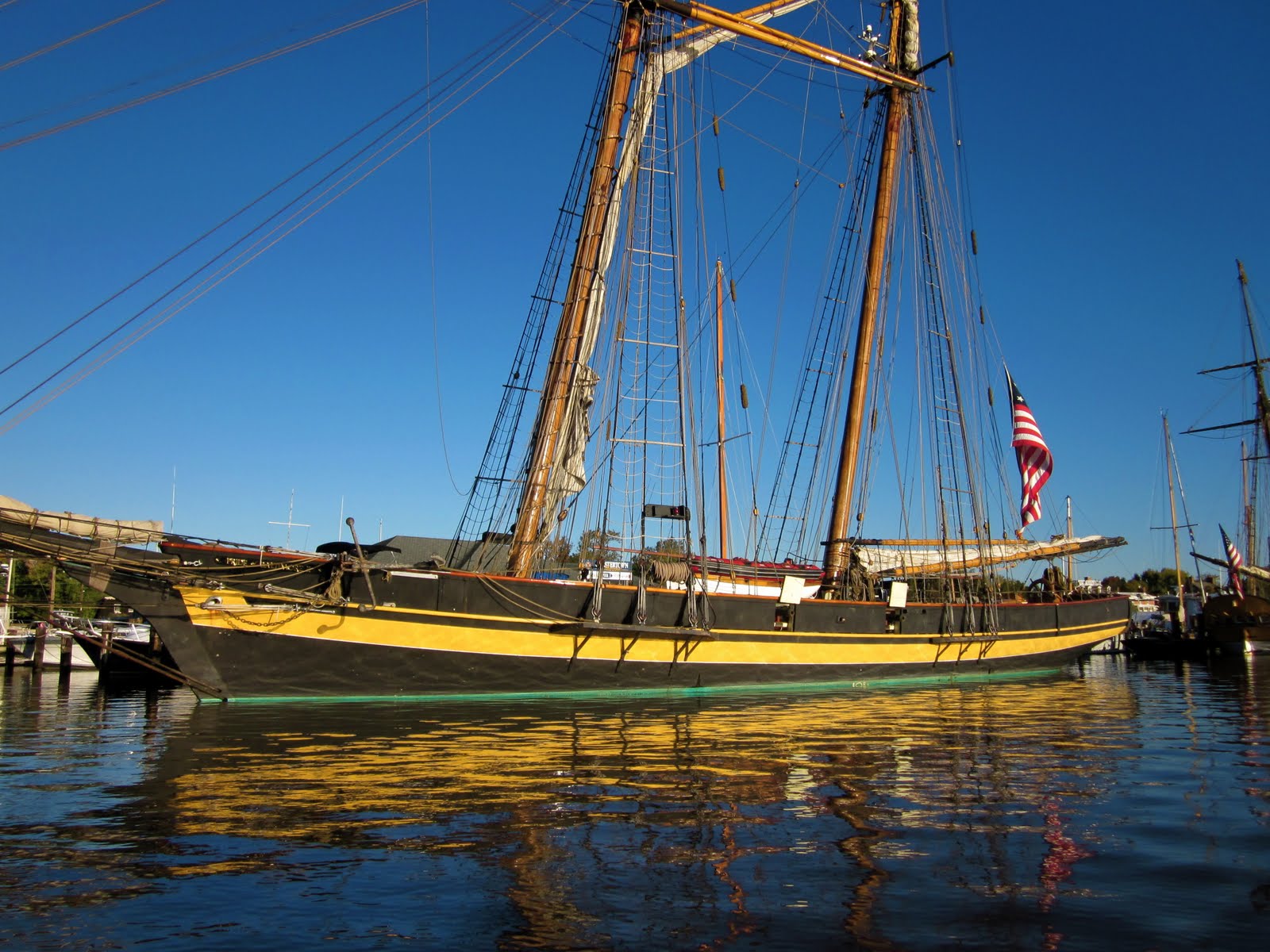
Once upon a time I wrote a book that featured a lean and rakish ship called the Hellfire. She was based on the nineteenth-century pilot schooners featured in Chapelle's The Search for Speed Under Sail and, more recently, embodied by the Pride of Baltimore II, Lynx, and others.
Just look at that photo of Lynx in a thundering reach on their homepage!
I put a ship called Hellfire in the book because I always wanted to name a ship that, I've always loved the look of these old schooners, and because I needed a dangerous and unmistakable vessel.
So when I got a chance to join Steve Earley for a sail this past weekend, I bundled up against the cold. Just after dawn we tacked up and down along the Chestertown waterfront, where the tall ships had gathered for Downrigging Weekend.

Steve's boat Spartina is the same Pathfinder design I'm building, and it's always inspiring to see that familiar shape in a completed boat. And even better to sail in a fresh breeze! OK, we had to tuck in a reef. And by "we" I mean "Steve."
As a clear sunrise warmed the frosty air, we slipped past Pride II and I shot a stream of photos.
Inspiration for the Hellfire:
Subscribe to:
Posts (Atom)