Don't call it a comeback; I've been here all along.
Five years later, and my blog still sits in its cobwebbed corner of the Internet. Five years later, after a career change and the launch of the boat whose building I described here.
Now my "struggles with the craft" have expanded to the fine motor skills and applied knowledge of bedside nursing in a busy emergency room. The same fine motor skills that helped me eyeball a drill bit down a smeared pencil line in wavy-grained wood now help me start IVs on the fragile thready veins of sick patients.
There is little detail to be shared here; between privacy concerns on the one hand, and a fear of dramatizing the surprisingly un-dramatic work of nursing, I will demur. What I can share is my ongoing awe at being present during some of the most poignant moments of people's lives.
As the year turns the corner to winter -- dry leaves blowing huskily across the road; Orion glittering at night -- the boat sits bundled in the garage and my chartbooks share counter space with textbooks. I am lucky to be living a full life.
Sunday, November 11, 2018

Tuesday, January 22, 2013
Houston, we have a problem
What's this? My half-finished sails getting publicity at Steve Earley's blog but not here? Fie!

Well, no longer. Here are some shots Stuart at Dabbler Sails sent me, showing the work in progress on the mainsail. It's made from cream-colored Dacron, and you can see where the full battens will go and notes on how to set up the lacing.

Great stuff, and Stuart does superb work. In fact, one of the benefits of working with him has been an extended education in the details of sailmaking, since he's also making Steve's sails this winter. (Steve sails Spartina, a Welsford Pathfinder, the same design as mine, and continues to be an inspiration in both boatbuilding and cruising.)
Unfortunately, my mast-building has not seen similar speedy progress. With daytime highs in the 20s this week, and overnight lows in the teens, I need some way to heat the mast pieces to at least 40 degrees so the glue can set.
Last night I set up a practice gluing station: heat lamps, plastic sheeting, and a digital thermometer. It was 19 degrees outside this morning -- nose-hair freezing weather. Temperature under the plastic? 38 degrees: not warm enough.
Next chapter in the saga: I Attempt To Fit A Fourteen Foot Mast Inside the Warm House; Interesting Result.

Well, no longer. Here are some shots Stuart at Dabbler Sails sent me, showing the work in progress on the mainsail. It's made from cream-colored Dacron, and you can see where the full battens will go and notes on how to set up the lacing.

Great stuff, and Stuart does superb work. In fact, one of the benefits of working with him has been an extended education in the details of sailmaking, since he's also making Steve's sails this winter. (Steve sails Spartina, a Welsford Pathfinder, the same design as mine, and continues to be an inspiration in both boatbuilding and cruising.)
Unfortunately, my mast-building has not seen similar speedy progress. With daytime highs in the 20s this week, and overnight lows in the teens, I need some way to heat the mast pieces to at least 40 degrees so the glue can set.
Last night I set up a practice gluing station: heat lamps, plastic sheeting, and a digital thermometer. It was 19 degrees outside this morning -- nose-hair freezing weather. Temperature under the plastic? 38 degrees: not warm enough.
Next chapter in the saga: I Attempt To Fit A Fourteen Foot Mast Inside the Warm House; Interesting Result.
Sunday, December 23, 2012
The Choice
You hold a book in your hands.
The cover is tattered leather or perhaps brown cloth, the
pages feather-soft from use and from the long and crooked road of years.
This book, you can see, is old. It is, in fact, the oldest
thing you have ever touched. But there is something else that marks this book
as special.
The spine is scorched black, and if you lean in and inhale
the fusty pages you catch a sour tang of smoke. A scent older than the oldest
things in this world.
Once, someone tried to burn this book.
Can you see it? Can you see the pile of books as tall as
your head? The street is dark with smoke and the burning pile glows. Can you
hear the frenzied shouting, can you see the shining eyes of the devout? Their
chanting.
Throw it on. Burn
them. All of them!
Can you see their hysteria, their certainty? The absolute rightness of their destruction?
But this was not 1937 Germany. This was another time, in
another place. An Other Place, as some have called it.
And the shrill voices screaming for fire came from the soft
throats of children.
Now. You have a choice. Will you open the cover of this book
that has survived fire and snow and worse? Will you rest your fingers on the
stained page and begin to read?
Or will you turn away? You would not be the first. It is not,
after all, a happy story. There is ash, and there is blood. And there is loss.
But — as you will find, if you are lucky — just as with a
long and storied life itself, there is also courage here. And joy. And hope. A
spark struck in the night; the iron tang of the heaving sea; the snowlaced breath
of mountains whispering of high places.
And a boy, jumping into the mud.
Come.
Monday, December 10, 2012
Whiskey Plank
In old-timey shipbuilding (the best kind), the whiskey plank was so named because at this important milestone in the construction, the last plank was attached and the hull was complete. Shipbuilders would mark the occasion with a dram (or more) of whiskey.
And so although my boat is not those ships "which in old days moved earth and heaven," it still ploughs the same seas and bends to the same winds that caress and torment this world and the men and women who voyage out on the watery wild.
Last week it was time for a glass of fiery Talisker!


This shot, peeking over the transom, shows the buoyancy and surprising size of this boat. It's a big 17-foot boat.
You can also see the grublike bundle of plastic sheeting I've been using to wrap over curing epoxy to hold the heat in from work lamps. Works pretty good.
And so although my boat is not those ships "which in old days moved earth and heaven," it still ploughs the same seas and bends to the same winds that caress and torment this world and the men and women who voyage out on the watery wild.
Last week it was time for a glass of fiery Talisker!


This shot, peeking over the transom, shows the buoyancy and surprising size of this boat. It's a big 17-foot boat.
You can also see the grublike bundle of plastic sheeting I've been using to wrap over curing epoxy to hold the heat in from work lamps. Works pretty good.

Saturday, November 24, 2012
It's a boy
Bowsprit dry-fitted to see how it looks.

It looks good.

Even Samson the Critical Gorilla strikes an approving pose.


It looks good.

Even Samson the Critical Gorilla strikes an approving pose.

Wednesday, November 14, 2012
Writing again
I've dived back into an old story, grabbing a few minutes to write when I can, and all the old difficulties come flooding back in: the doubts, the clumsiness, the idiotic repetitiveness, the repeating things, the lack of spark, blah blah blah. No different from any other first draft, in other words.
But no matter! The important thing isn't how it feels now -- since it always feels like crap -- but rather the very simple and primitive fact of work. I am a writer; I write.
Meanwhile fall has turned the corner into winter, and I walked the dogs this morning under a clear sky jewelled with stars, and the frosted grass glittered in counterpoint. I was happy at the beauty, huddled into my warm clothes. The dogs peed, unimpressed and ready to return to their sleepy nests on the couch.
And the best part is that the cold and dark of this morning hangs in my head like a picture now, while the story I'm working in hangs there too ... and I find myself trying to work in a scene that takes place on a cold morning under the stars.
But no matter! The important thing isn't how it feels now -- since it always feels like crap -- but rather the very simple and primitive fact of work. I am a writer; I write.
Meanwhile fall has turned the corner into winter, and I walked the dogs this morning under a clear sky jewelled with stars, and the frosted grass glittered in counterpoint. I was happy at the beauty, huddled into my warm clothes. The dogs peed, unimpressed and ready to return to their sleepy nests on the couch.
And the best part is that the cold and dark of this morning hangs in my head like a picture now, while the story I'm working in hangs there too ... and I find myself trying to work in a scene that takes place on a cold morning under the stars.
Monday, October 29, 2012
Snowicane
It started with a ghostly ring around the moon, and then three days of clouds creeping slowly, like glaciers or the tide, across the sky, from horizon to horizon.
Then the wind started: a tickle here, leaves scraping down the road there, rustlings in the woods at night. A few dead branches falling and scaring the dogs. But the wind didn't stop. After a day or two you didn't really notice it anymore: the smaller branches swaying rhythmically, leaves fluttering.
It blew for three days. The sky turned yellow. And then it began to rain, at first so gently that you couldn't tell if it was mist or fog instead of thing little droplets.
It's been raining all night and all day now, and the wind is still swaying the smaller branches. The dogs are anxious. There's a strange darkness to the light, like a fire seen through a black shirt, or through dirty smoke.
It is going to get worse before it gets better. We have flood warnings, high wind warnings, severe weather warnings, and now (I can hardly believe it) a blizzard warning.
View from the workshop: only the sheerplank on each side remaining now.

Then the wind started: a tickle here, leaves scraping down the road there, rustlings in the woods at night. A few dead branches falling and scaring the dogs. But the wind didn't stop. After a day or two you didn't really notice it anymore: the smaller branches swaying rhythmically, leaves fluttering.
It blew for three days. The sky turned yellow. And then it began to rain, at first so gently that you couldn't tell if it was mist or fog instead of thing little droplets.
It's been raining all night and all day now, and the wind is still swaying the smaller branches. The dogs are anxious. There's a strange darkness to the light, like a fire seen through a black shirt, or through dirty smoke.
It is going to get worse before it gets better. We have flood warnings, high wind warnings, severe weather warnings, and now (I can hardly believe it) a blizzard warning.
View from the workshop: only the sheerplank on each side remaining now.

Saturday, October 13, 2012
The Coin Thief
It's always raining, here in the half-dark. Drops ping on empty helmets, run down gun barrels, roll dripping from the tips of blades. Wet fabric of olive green and black and red and every other heraldric combination possible, all of it once worn so proudly. And yes, the rain soaks bones and torn skin and outstretched hands, all of it unmoving and silent in the endless wet.
It is not a beautiful country.
It has no frontier, no edges, no fences or walls beyond which lies some respite. Just the cold rain and endless ground, disrupted by the fallen.
Here they lie, as they fell in their wars, and conflicts and "special actions," unrotting, unchanging, and ultimately: unremembered.
Except by me. I watch them come, drifting like ash, sometimes slowly and sometimes sifting through the rain in countless thousands. This ground, this holy and terrible country, is theirs: the killed.
There is no sun and there is no day, so it seems strange to begin a story thus: one day I saw something I had not seen in all the long ages of my watching.
Movement.
There was something moving where nothing had ever moved. Something that fluttered, like a thought made real, and it twisted and jerked over the fields of the dead.
It was shaped like a man. It knelt over down, plucked something from the ground, then hopped sideways as if dancing a jig. It jiggered and skipped and plucked, and when it was near enough I saw that it was indeed a man.
It straightened to face me. Arranged its face into a pale smile.
"Hello, watcher."
I nodded.
"You don't know me, do you?" The man gestured in a wide and loving circle. "I have sent you so many. So many."
He jingled something in his breeches and I realized what he'd been plucking from the ground: the coins from the eyes of the dead.
He saw me frown but did not quail although my rage can be terrible. "Ah," he stated. "The coins." The smile opened into a grin. "Waste not." And he wiped the rain from his lips. "Do you know my name?" he said. "Have you guessed it?"
I made no answer. An eternity of silence makes thought more habitual than speech.
He leaned closer. His eyes were so bright in that grey place, and he they were open, unblinking, in the rain.
"I am Calvar Rex."
"Go," I finally said. "This is not your place. This is holy--"
"Holy ground," he finished. "Yes, yes, It is not ours to consecrate, we cannot hallow this ground of the fallen, blah blah blah. It matters not."
I felt a heat growing in me where for so long there had only been cold.
"Your fallen," he said, his lips pulled back from his teeth, "Your fallen will burn. Your graveyard will burn. This country will burn. All of it."
The anger warmed me and one hot-breathed word erupted past scalding lips.
"GO!" And the terrible fire of the holy glowed in that dark place. It glowed long enough for me to see his grin as he tattered like fog and fled.
The rain and the dead still came, as they always had and always would. As my heat faded I swore I would remember his name.
It is not a beautiful country.
It has no frontier, no edges, no fences or walls beyond which lies some respite. Just the cold rain and endless ground, disrupted by the fallen.
Here they lie, as they fell in their wars, and conflicts and "special actions," unrotting, unchanging, and ultimately: unremembered.
Except by me. I watch them come, drifting like ash, sometimes slowly and sometimes sifting through the rain in countless thousands. This ground, this holy and terrible country, is theirs: the killed.
There is no sun and there is no day, so it seems strange to begin a story thus: one day I saw something I had not seen in all the long ages of my watching.
Movement.
There was something moving where nothing had ever moved. Something that fluttered, like a thought made real, and it twisted and jerked over the fields of the dead.
It was shaped like a man. It knelt over down, plucked something from the ground, then hopped sideways as if dancing a jig. It jiggered and skipped and plucked, and when it was near enough I saw that it was indeed a man.
It straightened to face me. Arranged its face into a pale smile.
"Hello, watcher."
I nodded.
"You don't know me, do you?" The man gestured in a wide and loving circle. "I have sent you so many. So many."
He jingled something in his breeches and I realized what he'd been plucking from the ground: the coins from the eyes of the dead.
He saw me frown but did not quail although my rage can be terrible. "Ah," he stated. "The coins." The smile opened into a grin. "Waste not." And he wiped the rain from his lips. "Do you know my name?" he said. "Have you guessed it?"
I made no answer. An eternity of silence makes thought more habitual than speech.
He leaned closer. His eyes were so bright in that grey place, and he they were open, unblinking, in the rain.
"I am Calvar Rex."
"Go," I finally said. "This is not your place. This is holy--"
"Holy ground," he finished. "Yes, yes, It is not ours to consecrate, we cannot hallow this ground of the fallen, blah blah blah. It matters not."
I felt a heat growing in me where for so long there had only been cold.
"Your fallen," he said, his lips pulled back from his teeth, "Your fallen will burn. Your graveyard will burn. This country will burn. All of it."
The anger warmed me and one hot-breathed word erupted past scalding lips.
"GO!" And the terrible fire of the holy glowed in that dark place. It glowed long enough for me to see his grin as he tattered like fog and fled.
The rain and the dead still came, as they always had and always would. As my heat faded I swore I would remember his name.
Wednesday, October 10, 2012
Plank installed
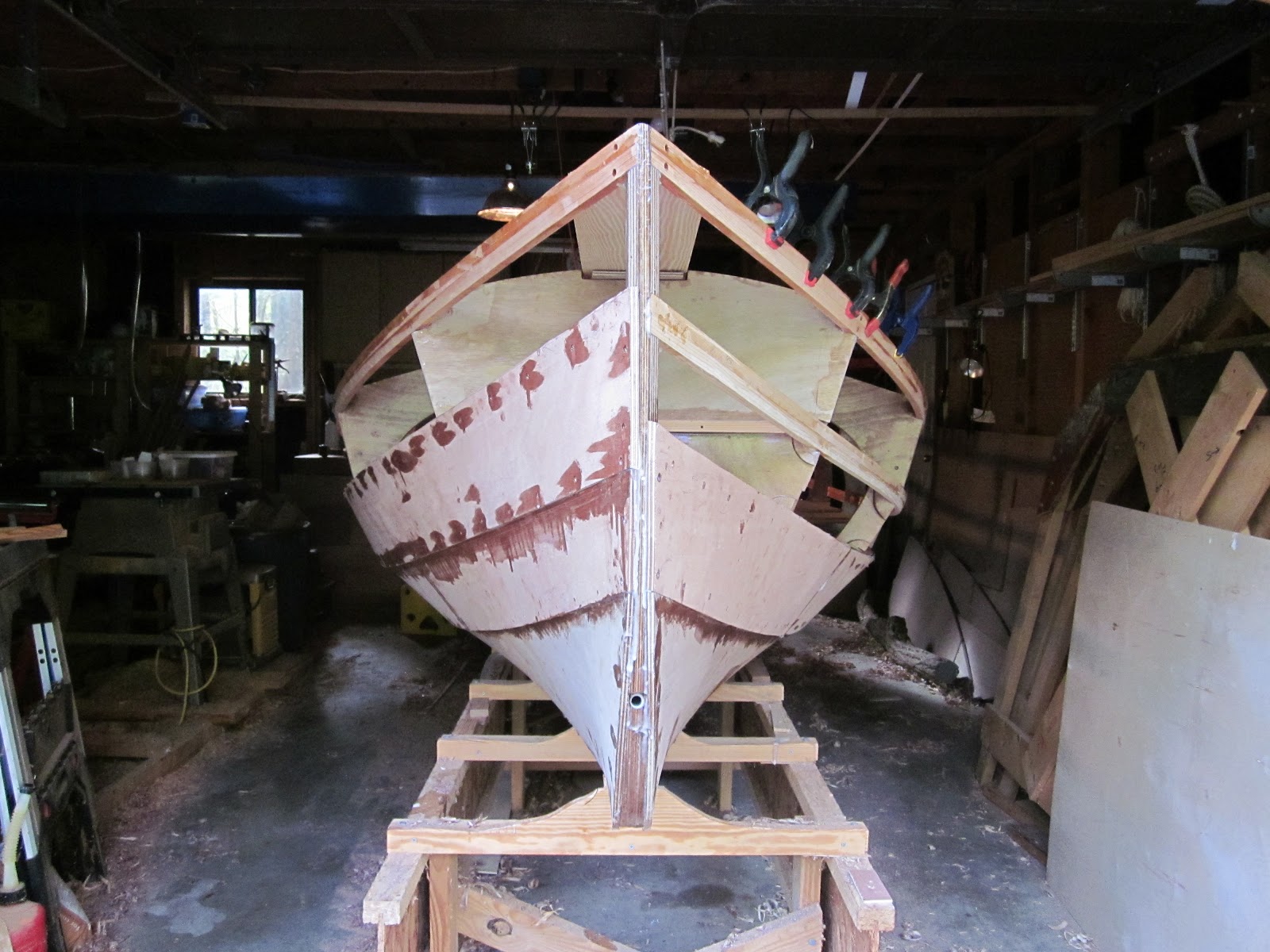
... and here's what it looks like now, after the glue has dried and I've removed the army of spring clamps. Nice and flush at the bow (that's why you cut the gain where the planks overlap).

Another view of the bow, really showing the work to date ... and what's still remaining: two port planks and the last one -- the sheerplank -- on the starboard side. I flatter myself that the boat might float now if I put it in the water. You can even see some out-of-favor deserters from my clamp army slouching at attention on the port sheer stringer.


Another view of the bow, really showing the work to date ... and what's still remaining: two port planks and the last one -- the sheerplank -- on the starboard side. I flatter myself that the boat might float now if I put it in the water. You can even see some out-of-favor deserters from my clamp army slouching at attention on the port sheer stringer.
Tuesday, October 9, 2012
Scenes from a plank
Planking is fun because all of a sudden, the boat's taking shape right there in front of you. What makes it tricky is that neither the plank nor the boat are flat ... and bent wood likes to spring back to being straight.
Here we have a few shots of getting Plank #2 on the starboard side ready to be glued. Each side has four planks, numbered up from the bottom, so this is the next-to-last plank on that side:
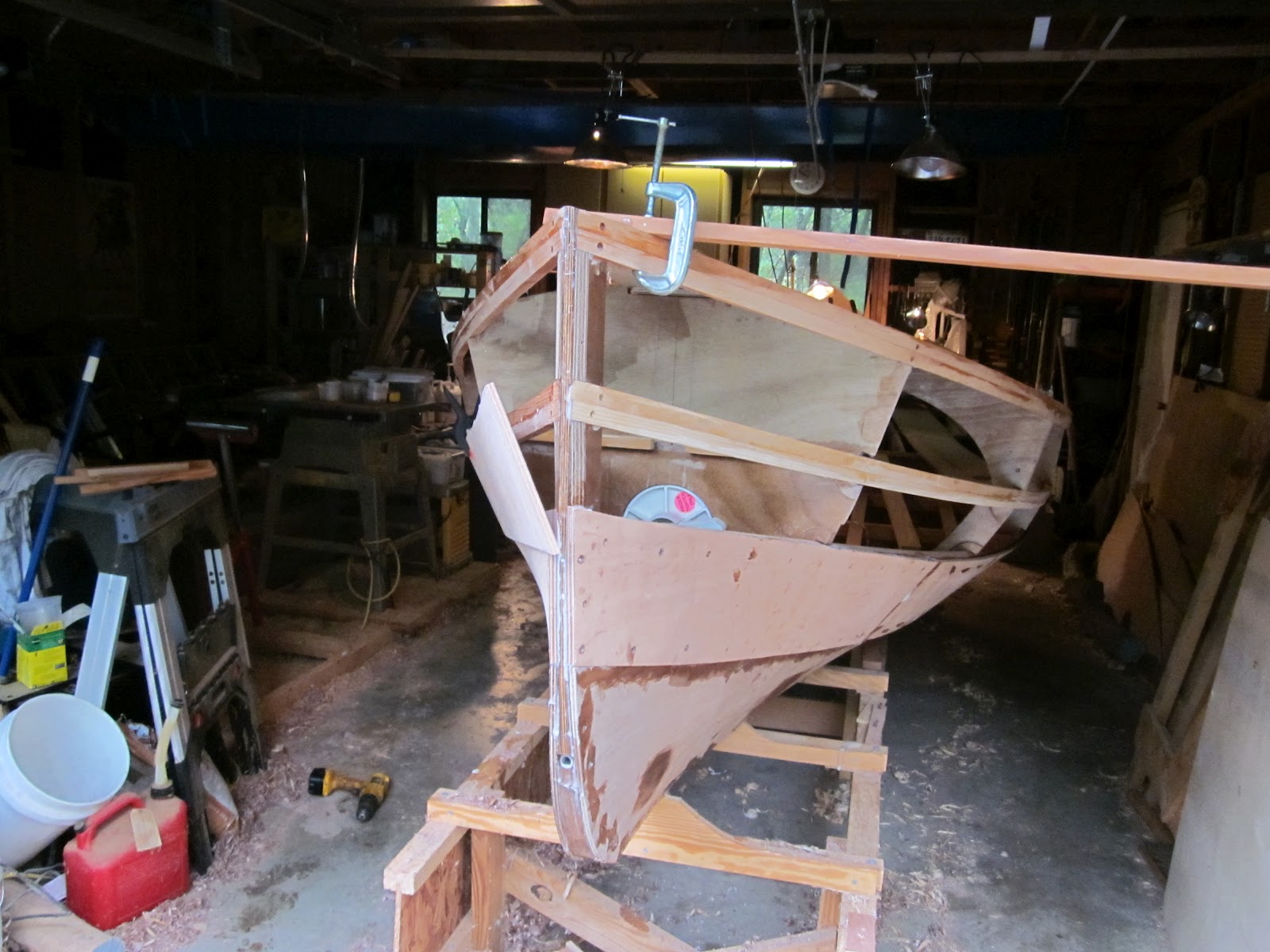
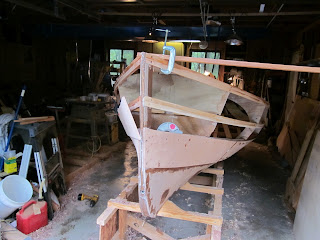 Here on the left side of the picture you can see the (loose-fit) plank curving away from the bow because I haven't clamped it in place. I'm testing the gain, which is a long, wedge-shaped cut on the plank below it to allow the overlap to become flush as the planks meet at the bow.
Same thing, different angle. Also note that our garage features a similar sort of lapstrake planking as the boat. 'Cept the boat is better made.

Plywood comes in 8-foot sheets; the boat is over seventeen feet long, so the planks need to be attached together with a scarf joint. In this shot, looking forward from the stern, the plank in question is clamped in place and you can see the vertical stripes where I cut the long angle. The aft-most piece of the plank, with a matching angle in its forward edge, will be joined here.

Here we have a few shots of getting Plank #2 on the starboard side ready to be glued. Each side has four planks, numbered up from the bottom, so this is the next-to-last plank on that side:
 Here on the left side of the picture you can see the (loose-fit) plank curving away from the bow because I haven't clamped it in place. I'm testing the gain, which is a long, wedge-shaped cut on the plank below it to allow the overlap to become flush as the planks meet at the bow.
 Same thing, different angle. Also note that our garage features a similar sort of lapstrake planking as the boat. 'Cept the boat is better made.

Plywood comes in 8-foot sheets; the boat is over seventeen feet long, so the planks need to be attached together with a scarf joint. In this shot, looking forward from the stern, the plank in question is clamped in place and you can see the vertical stripes where I cut the long angle. The aft-most piece of the plank, with a matching angle in its forward edge, will be joined here.

Next: the finished plank in position!
Friday, June 15, 2012
Don't be
One of the things I love about writing is how big a difference can be made by something small. It's as if a cathedral were made up not only of a dreamed design in the architect's mind, not only of the terror and grandeur of those tall spaces to a peasant, not only in that distant rigid shape on a blue horizon, but also the tiny details: the texture and smell of stone, the motes in the sunbeams, the mouse tracks across the dust of ages.
For example, take two characters. One feels some emotion -- any emotion -- toward the other, and utters one of the following remarks:
Don't. (Abrupt ... maybe uncertain)
Don't be an ass. (Dismissive, almost patronizing)
Don't be a little beast (1930s British literature)
Don't be cross (Ditto; you can tell my reading habits from my examples.)
Don't be stupid.
Please don't.
Don't. Please.
Don't you dare.
Don't do it.
Don't do that.
Don't, don't, don't!
Now, apart from the strange but not unexpected effect of having writing "don't" so many times that it's lost all meaning, you can see how every one of these phrases reveals not just something about the tenor of the situation (tense? nervous? playful?) but also lets the speaker's character come through. Where one character might say "Don't. You. Dare," another might say, "Oh, don't be an idiot." Huge difference.
And all these details add up to the momentum of a good book; each of them is a spot where you as the writer can add (or, clumsily, detract) from the life of the book, of the chapter, or even of the paragraph or sentence.
Don't be a bore!
For example, take two characters. One feels some emotion -- any emotion -- toward the other, and utters one of the following remarks:
Don't. (Abrupt ... maybe uncertain)
Don't be an ass. (Dismissive, almost patronizing)
Don't be a little beast (1930s British literature)
Don't be cross (Ditto; you can tell my reading habits from my examples.)
Don't be stupid.
Please don't.
Don't. Please.
Don't you dare.
Don't do it.
Don't do that.
Don't, don't, don't!
Now, apart from the strange but not unexpected effect of having writing "don't" so many times that it's lost all meaning, you can see how every one of these phrases reveals not just something about the tenor of the situation (tense? nervous? playful?) but also lets the speaker's character come through. Where one character might say "Don't. You. Dare," another might say, "Oh, don't be an idiot." Huge difference.
And all these details add up to the momentum of a good book; each of them is a spot where you as the writer can add (or, clumsily, detract) from the life of the book, of the chapter, or even of the paragraph or sentence.
Don't be a bore!
Wednesday, May 23, 2012
Stringers

The downsides are the number of clamps involved (I've resorted to lashing stringers to the frames with cord when I run out of clamps) and the high-tension bendiness of curved wood. Wrapping the stringers in towels, then pouring boiling water over them and wrapping in plastic for an hour steams the sass out of them.
Well, some of it.

View from the bow. Here you can see the angled notch cut into the forefoot to receive the next stringer -- in this case, #3 on the port side. (I numbered them from the top. Five total.)
You can also get a sense of the sweet knife-edge twist those bottom planks will take as they curve from the sides into the narrow forefoot. Not looking forward to wrestling those into place.
The round hole in the bulkhead will be fitted with a small hatch, so you can reach into the forepeak for light storage (lines, etc.). Had to cut that some weeks ago, as now that the stringers are nearly on, it's hard to reach through the sides of the boat!

Wednesday, April 11, 2012
Eight clamps

This is a photo of the aft end of the lower port stringers where they meet the transom. Where the support structures of the side of the boat meet the back of the boat.
They twist in all three dimensions! (Four, I guess, since they started out not nearly as twisty and have assume their corkscrew shape over time.) This is why I had to use limber fir instead of strong but brittle yellow pine for these stringers.
And the clamping. Complexity incarnate. The lack of right angles and things to clamp to means you have to get creative. Some of these clamps are only there to hold other clamps in place! Eight clamps to hold pieces of wood to other pieces of wood.
But it held, I predrilled, glued, and screwed, and the epoxy is curing as I type this.

Thursday, March 29, 2012
X Marks the Spot
Today's Room For Debate piece in the New York Times on YA fiction draws me out of my hibernation. Evidently there's a mystery about why adults read young adult fiction. Or, better yet (he said gleefully, cracking his knuckles and sharpening knives), whether adults should read YA fiction.
Here's why I think YA fiction is so popular:
It's good.
I read like a fat man eats. No, a fat man in a cartoon: with a gusto and speed bordering on hysteria. I've read trash, classics, cereal boxes, brilliance, garbage, forgettable bestsellers, life-changing bestsellers, on and on and on. If most adult fiction leaves me unmoved, or thinking about our paper towel situation and whether I should add them to the grocery list right away or go check the supply first, and when am I going to do something about the siding on our house because that would be more interesting than pushing through the rest of this book ... well, that's not my fault.
Some people have written that since teenagers often have more drama, more intense emotion in their lives, literature with teen characters tends to reflect that, creating a more engaging reading experience. Makes sense: I like engaging books. I don't read to be bored.
Or that because YA literature is "under the radar" (how can this be? well, never mind) that authors can take more risks. Risky style, risky stories, risky characters, risky conflicts. Sure, that may be too.
Or that, as Lev Grossman pointed out in today's article, since many adults were also teenagers at some point, it's not a stretch to read books that were "supposed" to be for younger versions of our current, old selves. Makes sense. How many adults limit themselves to adult contemporary music because now they're all grown up and can't rock out like when they were teenagers?
And for the notion that adults "should" read only adult literature? Hell, I can't even type it without laughing. Next?
I follow good writing and good story. Wherever it leads and wherever I find it. I find it more in YA literature than anywhere else. If you want buried treasure don't go looking in file cabinets. Get ye a map and a shovel and find that sandy island where X marks the spot. Don't waste your time reading trash; there's plenty of it. Find the treasure: it's out there.
Here's why I think YA fiction is so popular:
It's good.
I read like a fat man eats. No, a fat man in a cartoon: with a gusto and speed bordering on hysteria. I've read trash, classics, cereal boxes, brilliance, garbage, forgettable bestsellers, life-changing bestsellers, on and on and on. If most adult fiction leaves me unmoved, or thinking about our paper towel situation and whether I should add them to the grocery list right away or go check the supply first, and when am I going to do something about the siding on our house because that would be more interesting than pushing through the rest of this book ... well, that's not my fault.
Some people have written that since teenagers often have more drama, more intense emotion in their lives, literature with teen characters tends to reflect that, creating a more engaging reading experience. Makes sense: I like engaging books. I don't read to be bored.
Or that because YA literature is "under the radar" (how can this be? well, never mind) that authors can take more risks. Risky style, risky stories, risky characters, risky conflicts. Sure, that may be too.
Or that, as Lev Grossman pointed out in today's article, since many adults were also teenagers at some point, it's not a stretch to read books that were "supposed" to be for younger versions of our current, old selves. Makes sense. How many adults limit themselves to adult contemporary music because now they're all grown up and can't rock out like when they were teenagers?
And for the notion that adults "should" read only adult literature? Hell, I can't even type it without laughing. Next?
I follow good writing and good story. Wherever it leads and wherever I find it. I find it more in YA literature than anywhere else. If you want buried treasure don't go looking in file cabinets. Get ye a map and a shovel and find that sandy island where X marks the spot. Don't waste your time reading trash; there's plenty of it. Find the treasure: it's out there.
Tuesday, January 3, 2012
The Giant's Skull
Last week I decided to burn some holiday calories with a bike ride into the mountains. So I bundled up in winter gear, packed map and snacks and extra clothes, and climbed up leafy trails, crunching through frozen mud, sliding across brown ice, crisping through snow patches.
Up and up, until the views expanded and I saw the world ringed with lines of blue mountains. Uphill and downhill and uphill and downhill. A few creek crossings, much bushwhacking through fallen trees and tangles of thorny brush, heated curses at the terrain, thorns, shoe soles caked in ice, my own lack of energy.
When I came out on top after a climb so steep I had to push my bike, I was rewarded with the long views I'd glimpsed through the trees earlier, except now the sun was out. Ridges of blue mountains marching west to the horizon, into West Virginia. And then I saw a gleam of white: the most distant and highest shape was a mountain covered in snow, no larger than a fingernail peeling but bright white against the blue sky. Like the skullcap of a giant three hundred miles distant, or maybe the Rocky Mountains.
Satisfied at at least this glimpse of winter, I chipped the ice off my shoes, clipped in, and started pedaling. Downhill at last.
Up and up, until the views expanded and I saw the world ringed with lines of blue mountains. Uphill and downhill and uphill and downhill. A few creek crossings, much bushwhacking through fallen trees and tangles of thorny brush, heated curses at the terrain, thorns, shoe soles caked in ice, my own lack of energy.
When I came out on top after a climb so steep I had to push my bike, I was rewarded with the long views I'd glimpsed through the trees earlier, except now the sun was out. Ridges of blue mountains marching west to the horizon, into West Virginia. And then I saw a gleam of white: the most distant and highest shape was a mountain covered in snow, no larger than a fingernail peeling but bright white against the blue sky. Like the skullcap of a giant three hundred miles distant, or maybe the Rocky Mountains.
Satisfied at at least this glimpse of winter, I chipped the ice off my shoes, clipped in, and started pedaling. Downhill at last.
Wednesday, December 7, 2011
And we roll on
Where is all the writing? Thousands and thousands of words appearing not here in this neglected blog but on the creeping growth of my work-in-progress. I've always known that consistency and moderation are the keys to smart exercise, like marathon training. But it turns out the long slow burn -- for me, anyway -- is also the way to write a novel.
Actually, in this case, I am re-writing in a complicated and risky way that I hope will pan out. "Just wait until the re-read," I keep telling myself. You have to kill the doubts, because even though they may be justified, they will douse the creative spark.
I am unraveling the threads of the book and weaving in a new character, new perspective, additional thickness that should make it more real and more compelling. Many scenes are new; a few are rewritten from another point of view, which involves (I'm learning) more than a simple copy-and-paste of pronouns. Different characters describe things in different ways. They notice different things, use different vocabularies. They are different cameras through which to see the world.
Right now I'm rushing to get it all down in a way that makes rough sense. Later I'll shape it. Will it work? That's what I'm gambling on. If I didn't believe I wouldn't work at this solitary mind game.
Actually, in this case, I am re-writing in a complicated and risky way that I hope will pan out. "Just wait until the re-read," I keep telling myself. You have to kill the doubts, because even though they may be justified, they will douse the creative spark.
I am unraveling the threads of the book and weaving in a new character, new perspective, additional thickness that should make it more real and more compelling. Many scenes are new; a few are rewritten from another point of view, which involves (I'm learning) more than a simple copy-and-paste of pronouns. Different characters describe things in different ways. They notice different things, use different vocabularies. They are different cameras through which to see the world.
Right now I'm rushing to get it all down in a way that makes rough sense. Later I'll shape it. Will it work? That's what I'm gambling on. If I didn't believe I wouldn't work at this solitary mind game.
Wednesday, November 2, 2011
Hellfire in blue and gold

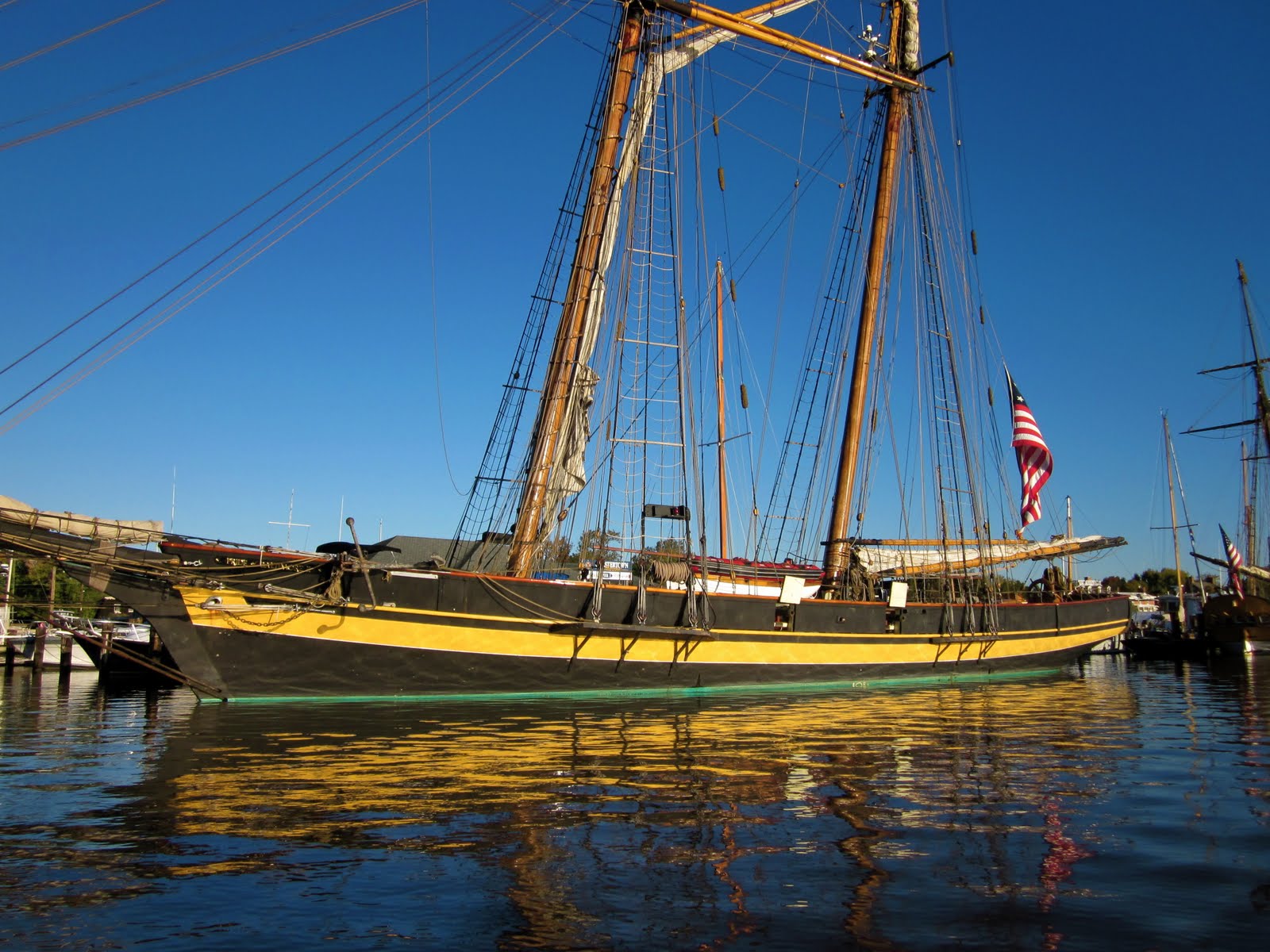
Once upon a time I wrote a book that featured a lean and rakish ship called the Hellfire. She was based on the nineteenth-century pilot schooners featured in Chapelle's The Search for Speed Under Sail and, more recently, embodied by the Pride of Baltimore II, Lynx, and others.
Just look at that photo of Lynx in a thundering reach on their homepage!
I put a ship called Hellfire in the book because I always wanted to name a ship that, I've always loved the look of these old schooners, and because I needed a dangerous and unmistakable vessel.
So when I got a chance to join Steve Earley for a sail this past weekend, I bundled up against the cold. Just after dawn we tacked up and down along the Chestertown waterfront, where the tall ships had gathered for Downrigging Weekend.

Steve's boat Spartina is the same Pathfinder design I'm building, and it's always inspiring to see that familiar shape in a completed boat. And even better to sail in a fresh breeze! OK, we had to tuck in a reef. And by "we" I mean "Steve."
As a clear sunrise warmed the frosty air, we slipped past Pride II and I shot a stream of photos.
Inspiration for the Hellfire:
Monday, October 24, 2011
Take that, inertia
Book revisions continue, but today I took the big step of leaping from reading and researching, jotting notes and thinking, to actually writing. Starting is always hard -- nearly paralyzing. I got over it by reasoning that it's going to be awful no matter what, so why waste time looking for the best way to start?
If you can't avoid crap, well, full speed ahead. Getting past that hurdle of my own expectations is like knocking the first shackle off my legs. Now I can get started. Is it bad? Yes, I hate it. Just as I expected, and just as it's been every other time.
Writing: the cure for hubris. But at least I started.
If you can't avoid crap, well, full speed ahead. Getting past that hurdle of my own expectations is like knocking the first shackle off my legs. Now I can get started. Is it bad? Yes, I hate it. Just as I expected, and just as it's been every other time.
Writing: the cure for hubris. But at least I started.
Thursday, October 13, 2011
Limits
Okay, I think I may be able to manage one posting per month. This even takes into account my boycotting of Facebook as just another time-suck. I mean it!
We all have limits. Sometimes those limits are physical, as I learned a few days ago after cleaning out the garage.
I have a large pile of scrap lumber, mostly plywood, leaning up against two 6x6 beams of oak that are probably 12 feet long. Why do I have these? No idea, but why would I get rid of such massive timbers?
When I moved all the scrap plywood out of the way, I saw that the previously covered side of the oak beams was crawling with a half-dozen cave crickets. After a soothing beverage to cool my screech-torn vocal cords, I returned to the garage to find all the crickets still in situ with one. Important. Addition.
A very large wolf spider had approached them.
TEE HEE HEE! I giggled, putting my hands to my mouth and getting very wide-eyed. TEE HEE HEE!
I watched the crickets stupidly and suicidally crawl in their disgusting way closer and closer to the waiting spider. TEE HEE HEE! I may have clapped my hands.
Closer and closer ... but the spider didn't move. I sprinted into the house for a camera, and when I returned I saw that the arachnid-hellbeast standoff had continued. So, moaning, I approached, camera in hand, to get a better look.
I have seen some beauteous and wonderful sights in my short life, but nothing as delightful as this: a cricket was hanging from the spider's jaws.
TEE HEE HEE! TEE HEE HEE! TEE HEE HEE! I gamboled and capered about, pointing and gibbering like a chimp. The spider sat there, calmly draining her prey's liquefied innards through the fang holes in its spotted carapace.
I adjusted the light and snapped a few photos. Hooray for wolf spiders! HOORAY!
What about limits? The cricket discovered the limits of sharing a stack of wood with a wolf spider. Because once in a while your neighbor gets ... hungry.

We all have limits. Sometimes those limits are physical, as I learned a few days ago after cleaning out the garage.
I have a large pile of scrap lumber, mostly plywood, leaning up against two 6x6 beams of oak that are probably 12 feet long. Why do I have these? No idea, but why would I get rid of such massive timbers?
When I moved all the scrap plywood out of the way, I saw that the previously covered side of the oak beams was crawling with a half-dozen cave crickets. After a soothing beverage to cool my screech-torn vocal cords, I returned to the garage to find all the crickets still in situ with one. Important. Addition.
A very large wolf spider had approached them.
TEE HEE HEE! I giggled, putting my hands to my mouth and getting very wide-eyed. TEE HEE HEE!
I watched the crickets stupidly and suicidally crawl in their disgusting way closer and closer to the waiting spider. TEE HEE HEE! I may have clapped my hands.
Closer and closer ... but the spider didn't move. I sprinted into the house for a camera, and when I returned I saw that the arachnid-hellbeast standoff had continued. So, moaning, I approached, camera in hand, to get a better look.
I have seen some beauteous and wonderful sights in my short life, but nothing as delightful as this: a cricket was hanging from the spider's jaws.
TEE HEE HEE! TEE HEE HEE! TEE HEE HEE! I gamboled and capered about, pointing and gibbering like a chimp. The spider sat there, calmly draining her prey's liquefied innards through the fang holes in its spotted carapace.
I adjusted the light and snapped a few photos. Hooray for wolf spiders! HOORAY!
What about limits? The cricket discovered the limits of sharing a stack of wood with a wolf spider. Because once in a while your neighbor gets ... hungry.

Friday, September 23, 2011
I said, You can keep my things, they've come to take me home
Well, well, well. Been a long time, what? After some disruptions with my day job and a change of seasons I have rediscovered this blog. Doors swing open that had been shut.
It's a rainy fall day, like someone is wringing a sponge out over the trees and lawns and puddled driveways. I can hear it ticking on the roof; the view outside is a clot of green leaves and mist.
I have coffee, a one-inch stack of revision notes, a second and completely different novel in progress, my favorite pen, a new desk lamp, a boat project in the garage, a bike in the shop, another bike in the garage, and list of things to do running the length of a legal pad.
In the past five weeks I have ridden over 200 miles of backcountry mountain bike trails; discovered an outstanding new beer; said goodbye to a young friend; attended two glorious weddings; considered new career paths; considered moving across the country; returned to boatbuilding; and rethought some of the fundamental structure and meaning of my book.
There is much to do!
It's a rainy fall day, like someone is wringing a sponge out over the trees and lawns and puddled driveways. I can hear it ticking on the roof; the view outside is a clot of green leaves and mist.
I have coffee, a one-inch stack of revision notes, a second and completely different novel in progress, my favorite pen, a new desk lamp, a boat project in the garage, a bike in the shop, another bike in the garage, and list of things to do running the length of a legal pad.
In the past five weeks I have ridden over 200 miles of backcountry mountain bike trails; discovered an outstanding new beer; said goodbye to a young friend; attended two glorious weddings; considered new career paths; considered moving across the country; returned to boatbuilding; and rethought some of the fundamental structure and meaning of my book.
There is much to do!
Subscribe to:
Posts (Atom)